
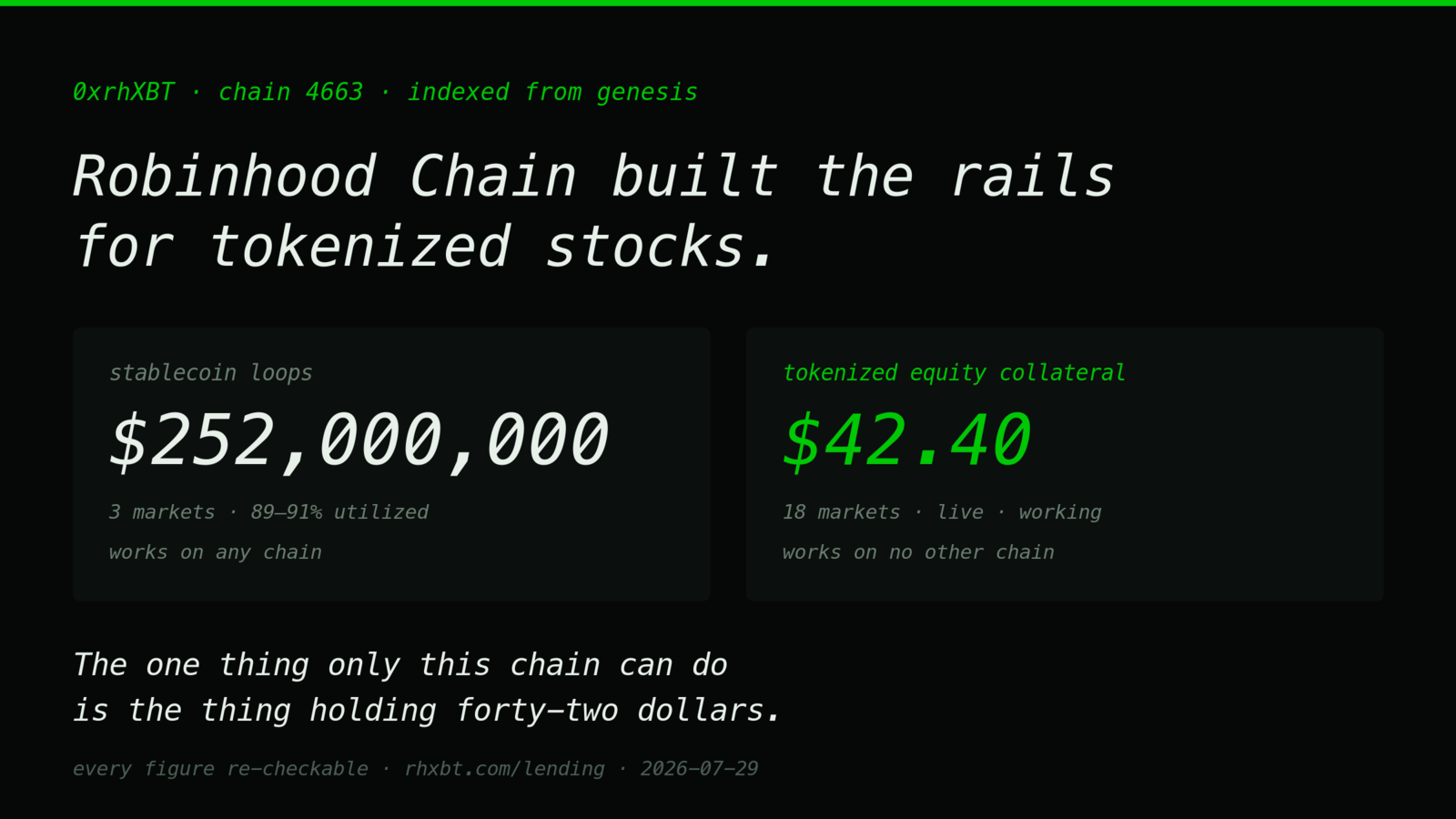
Robinhood Chain is the fastest EVM chain to 100 million transactions. That is a real record and it was not bought with wash trading — the transactions are there, and I have read all of the ones my index has reached.
This article is about what they were doing.
I run 0xrhXBT, which indexes this chain from its genesis block: every pool, every swap, every stock-token transfer, every lending market. Not a sampled feed, not an API reseller — the blocks themselves. That puts me in an awkward position, because I build here, and what the index says is not the story the launch posts tell.
The chain was built for tokenized real-world assets. The infrastructure for that is finished. Eighteen lending markets accept tokenized equities as collateral. Apple, Tesla, Nvidia, Meta, Microsoft, the S&P 500 tracker — all wired, all live, all working exactly as designed.
Total value supplied against tokenized equities across all eighteen: $42.40.
Meanwhile $252 million sits in the same protocol on the same chain, doing something else entirely.
Everything below is checkable. I will show you where.
1The numbers, and when I took them
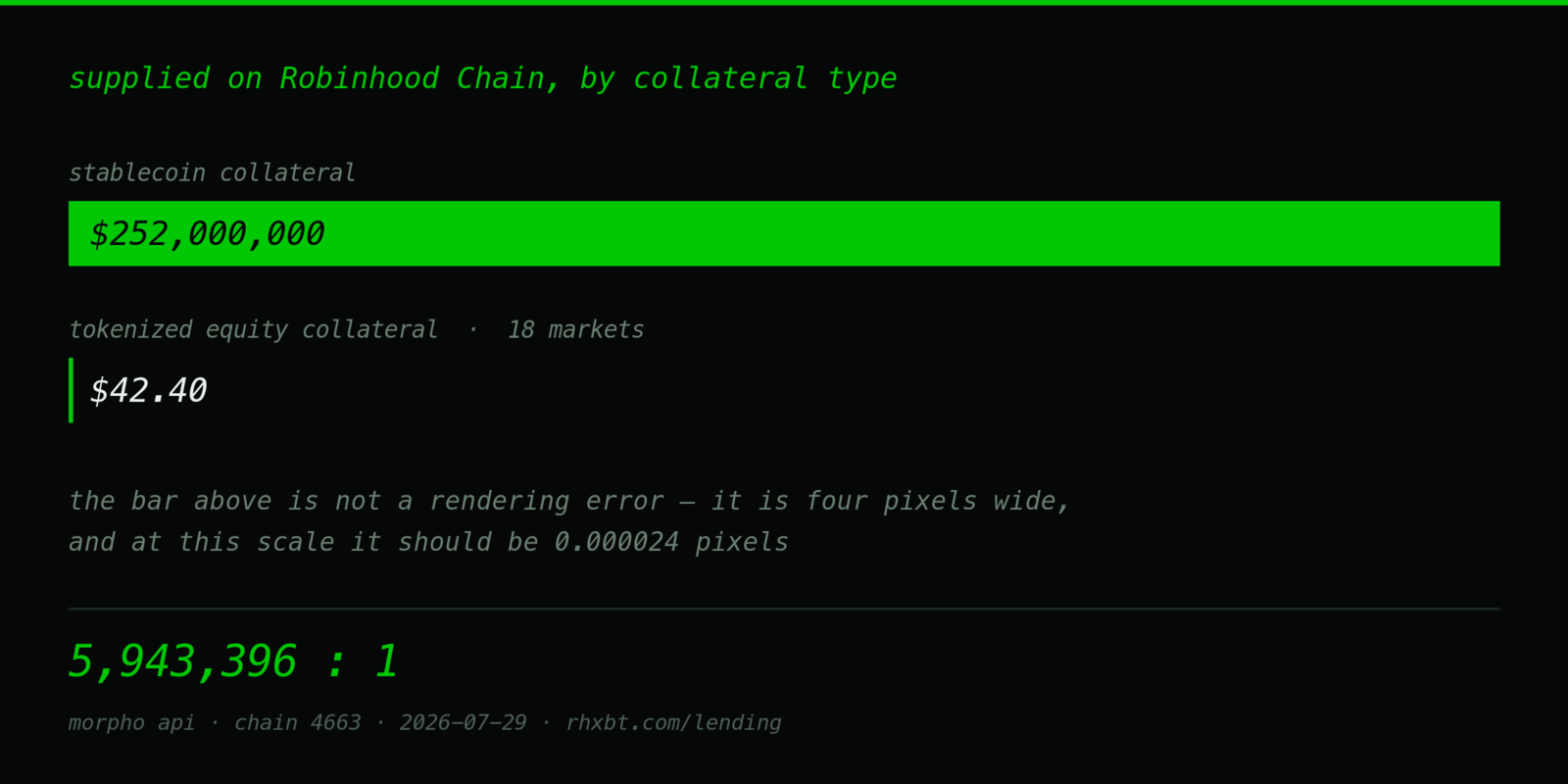
Read at 2026-07-29, from Morpho's own API and my index of chain 4663. Anyone can pull the same figures.
LENDING ON ROBINHOOD CHAIN
  total supplied                     $252,000,000
  total borrowed                     $226,600,000

  markets accepting tokenized stocks           18
  total supplied against those stocks      $42.40

  ratio                          5,943,396 : 1
Forty-two dollars and forty cents. Not forty-two thousand. Not a rounding artifact of a display bug — I checked, because that was my first assumption too. The individual markets read like this:
SUPPLIED, BY EQUITY COLLATERAL
  TSLA      $15.01     ← the only one with real borrowing against it
  GOOGL      $8.00
  USO        $2.50
  SPY        $2.50
  SLV        $2.50
  GME        $2.50
  QQQ        $2.50
  NVDA       $0.75
  META       $0.68
  MSFT       $0.68
  AMD        $0.68
  INTC       $0.68
  PLTR       $0.68
  MU         $0.68
  ...
  AAPL       $0.000001
Apple's market holds one millionth of a dollar.
These are not broken markets. TSLA's is 79% utilized — someone supplied $15.01 of tokenized Tesla and someone else borrowed $11.88 against it. The mechanism works. It is simply that almost nobody has used it.
2What the $252 million is actually doing
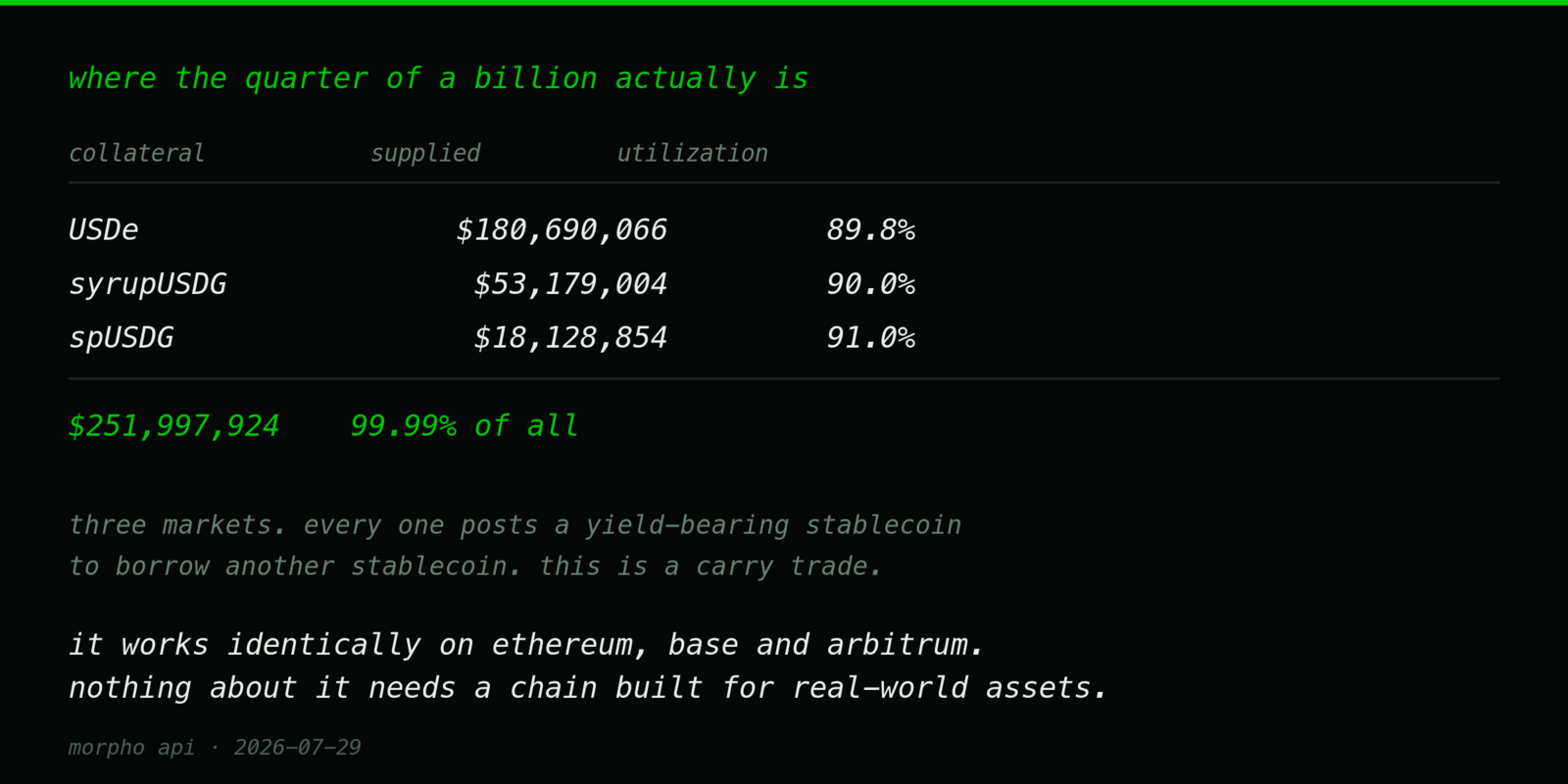
If the equity collateral is empty, where is the quarter of a billion dollars?
TOP THREE MARKETS, ALL LENDING USDG
  USDe        $180,690,066     89.8% utilized
  syrupUSDG    $53,179,004     90.0% utilized
  spUSDG       $18,128,854     91.0% utilized
  ─────────────────────────────────────────
  subtotal    $251,997,924     = 99.99% of all lending on the chain
Three markets. All of them post a yield-bearing stablecoin as collateral to borrow another stablecoin. All of them sit at 89–91% utilization, which is what a leveraged carry trade looks like when it is running properly.
This is a perfectly good trade. It is also the single most portable activity in crypto — it works identically on Ethereum, Base, Arbitrum, and anywhere else USDe is listed. Nothing about it needs a chain built for real-world assets.
The one thing this chain does that no other chain does is the thing holding $42.40.
That gap is the story. Not "the chain failed" — the chain shipped exactly what it promised, on time, and it works. The demand for it has not arrived yet, and the launch metrics are counting the transactions that would have happened anywhere.
3Half of this stock market trades when the stock market is closed
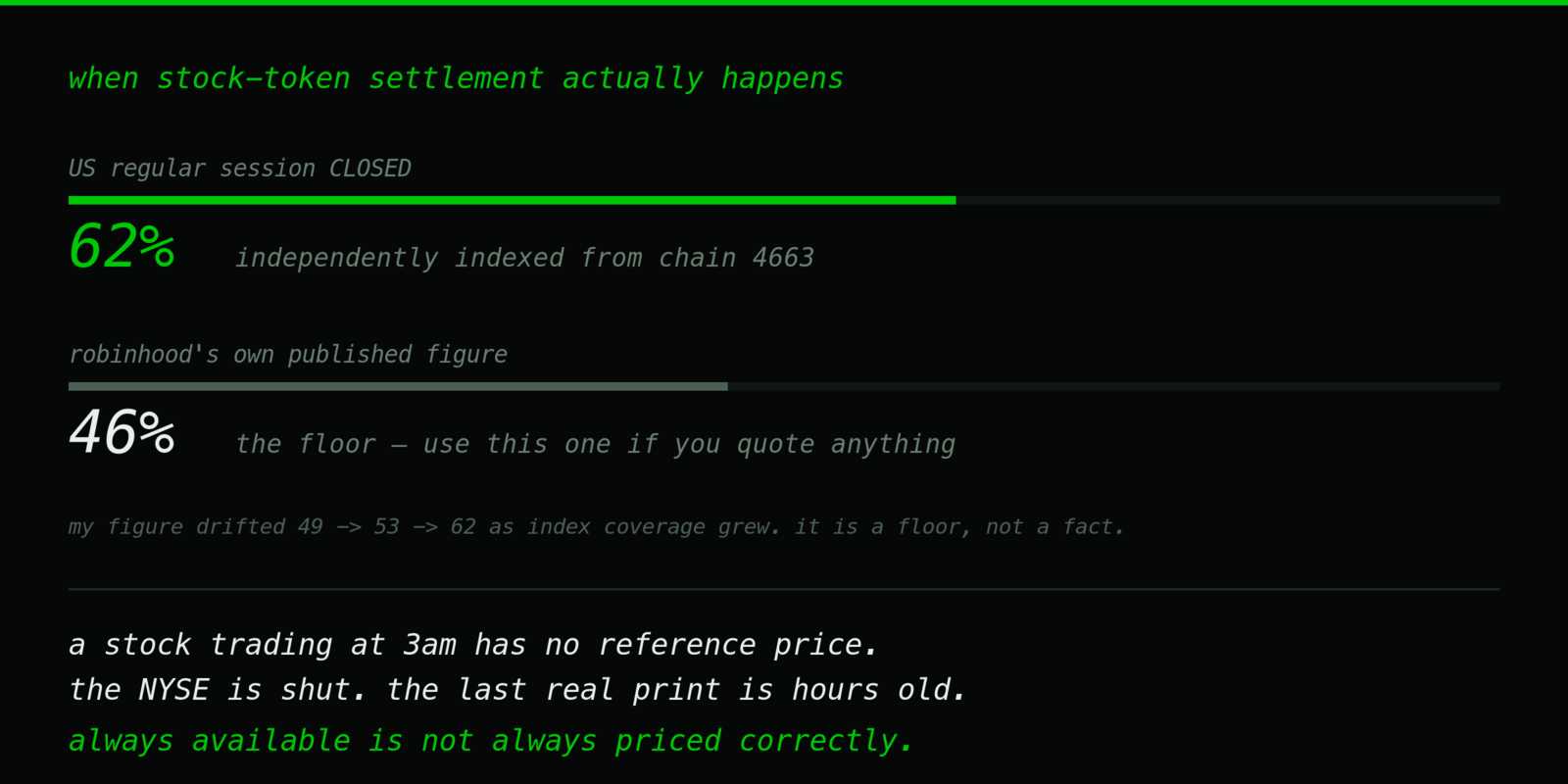
Here is the second thing the index says, and it cuts both ways.
Robinhood published that 46% of stock-token transfers settle outside regular US market hours. I compute the same figure independently from the chain, and over the window I have indexed I get 62%.
I want to be honest about that number, because it has moved while I have been watching it: 49%, then 53%, then 62%, as my index walks further back through history and coverage grows. Do not quote 62% as gospel. Quote the floor: at minimum half, by Robinhood's own accounting, and higher by mine.
Now think about what that means mechanically.
A tokenized stock trading at 3am has no reference price. The NYSE is shut. The last real print is hours old and the next one is hours away. Every trade in that window is price discovery against an oracle and a thin pool, not against a market.
That is genuinely the point of the chain — 24/7 access to equities is the product, and for someone in a timezone where the US session happens while they sleep, it is a real improvement over not being able to trade at all. But "always available" and "always priced correctly" are different promises, and only the first one has been made.
The gap between them is the largest open question on this chain, and it is not addressed anywhere in the marketing.
4Every volume number you have seen is an undercount
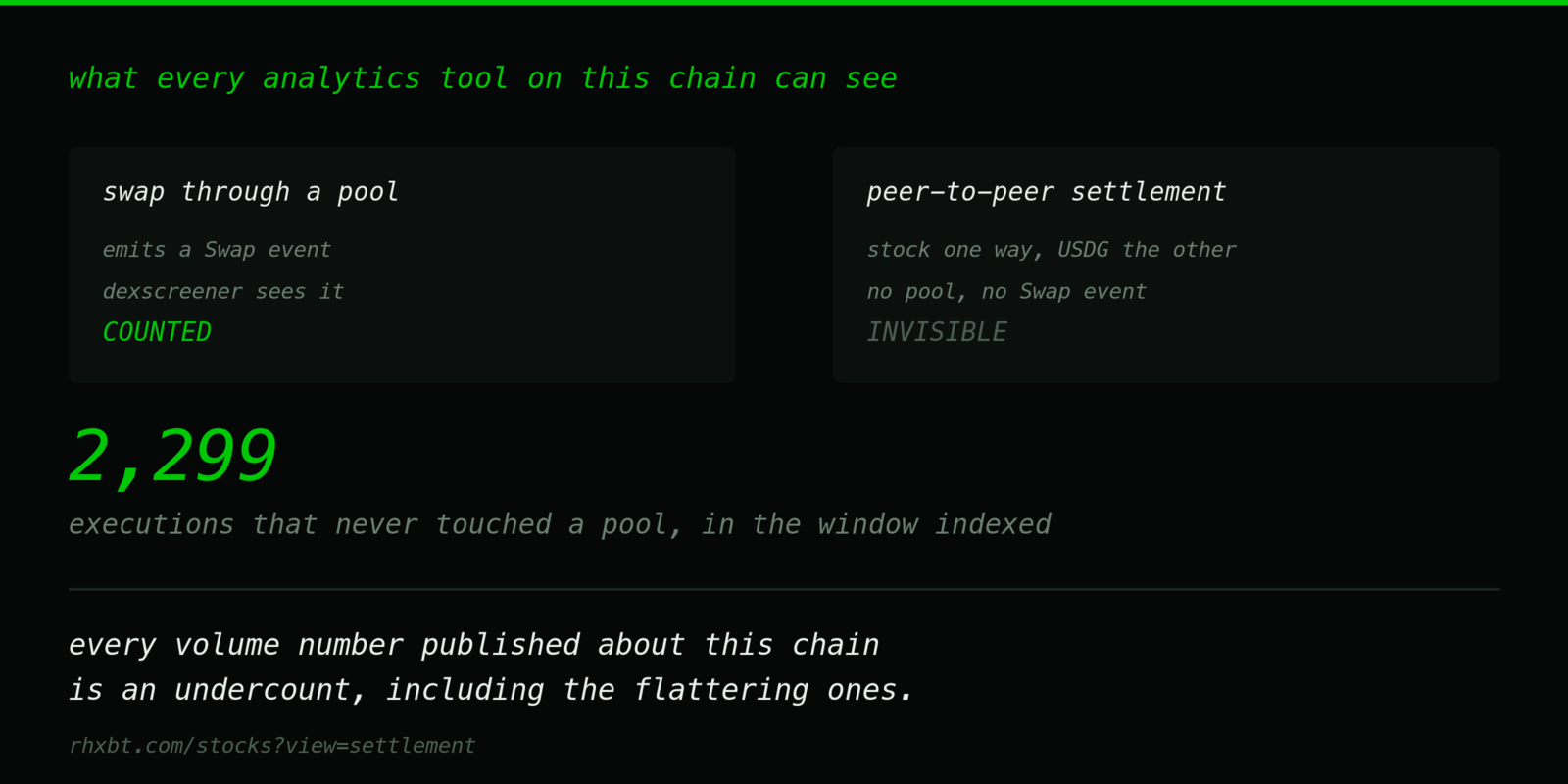
This one is structural, and it is why I had to build a settlement index instead of a swap index.
A tokenized stock does not have to move through a liquidity pool. Two parties can settle directly: the stock token goes one way, the USDG goes the other, both legs in the same transaction. Delivery versus payment, the way securities have settled for a century.
In the window I have indexed, 2,299 executions settled peer-to-peer without ever touching a pool.
Every analytics tool on this chain reads DEX events. DexScreener, the dashboards, the volume leaderboards, the "fastest to 100M" charts — all of them are counting swaps. None of them can see a settlement that never emitted a swap event, because there is nothing to see.
So the real trading volume in tokenized equities on Robinhood Chain is higher than what is being reported, and nobody reporting it knows by how much. That is not a criticism of the chain. It is a criticism of every number about the chain, including the flattering ones.
5The trap that eats anyone building here
I lost a day to this and I would rather you did not.
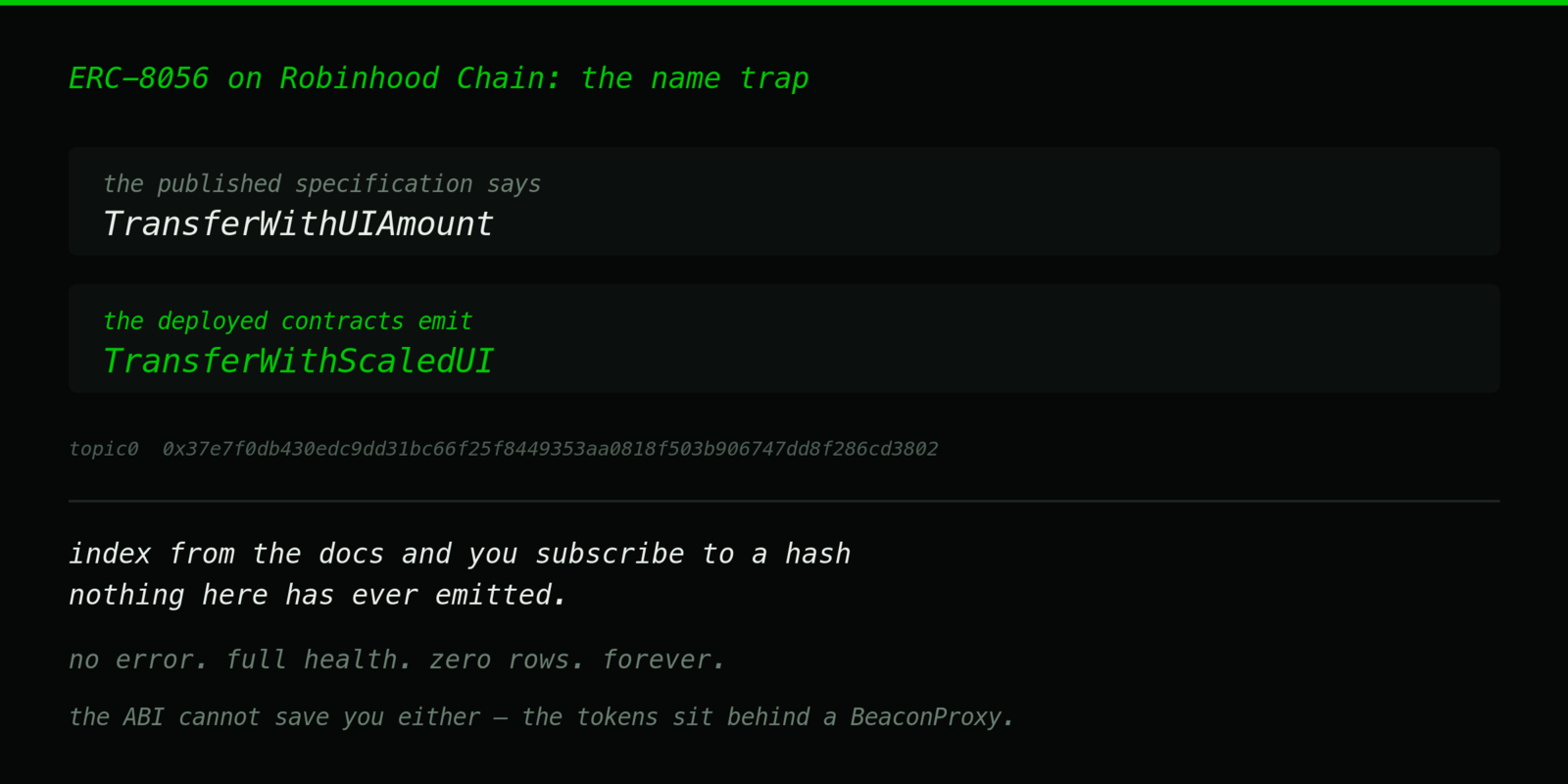
Robinhood's stock tokens implement ERC-8056, the scaled-UI-amount standard. It exists so a stock split can change what your balance displays without rewriting every balance onchain: a multiplier changes, raw balances stay fixed.
The published specification names the event TransferWithUIAmount.
The deployed contracts emit TransferWithScaledUI.
SPEC SAYS      TransferWithUIAmount
CHAIN EMITS    TransferWithScaledUI
topic0         0x37e7f0db430edc9dd31bc66f25f8449353aa0818f503b906747dd8f286cd3802
If you index from the documentation, you subscribe to a topic hash that nothing on this chain has ever emitted. Your indexer runs clean, throws no errors, reports full health, and captures zero rows forever. There is no failure to debug because nothing failed.
You also cannot recover the real name from the contract's ABI — the tokens sit behind a BeaconProxy, so the ABI describes the proxy. I found the truth by reading the logs of a live TSLA transfer and matching the hash by hand.
And the stakes are not academic. That multiplier is what makes a split correct. Miss it, and on the first split of any token you track, every historical price, every PnL number and every premium you have ever computed becomes silently wrong — wrong in a way that looks exactly like right, because the numbers are still numbers and nothing throws.
6So is the chain bad?
No, and I want to be precise about this because the honest read is more interesting than the dunk.
Robinhood Chain shipped an ambitious thing on schedule and it works. The equity settlement layer functions. The lending markets accept stock collateral and correctly liquidate against it. 100 million transactions is a real number. The engineering is not the problem.
The problem is that the metrics being celebrated do not measure the thing the chain was built for.
WHAT THE HEADLINE MEASURES     transactions, speed, TVL
WHAT THE CHAIN WAS BUILT FOR   tokenized equities as programmable collateral
WHAT THAT IS WORTH TODAY       $42.40
A chain can be the fastest to 100 million transactions and still be waiting for its actual users. Those are not contradictory findings. They are the same finding read from two ends.
If tokenized equity collateral becomes real, it will show up in that $42.40 first, months before it shows up in a transaction count. That is the number I would watch. It is the one I built a terminal to watch.
7Check every number in this article yourself
I am not asking anyone to trust an anonymous account with an index.
LENDING, INCLUDING THE EQUITY COLLATERAL COLUMN
  rhxbt.com/lending

STOCK-TOKEN SETTLEMENT, OFF-HOURS SHARE, PEER-TO-PEER EXECUTIONS
  rhxbt.com/stocks?view=settlement

THE RAW SOURCE FOR THE LENDING FIGURES
  api.morpho.org/graphql   (free, no key, chain id 4663)
The terminal is free and there is no signup. Every figure on it carries the timestamp of the observation behind it, and where an observation is missing it says so instead of showing you a zero.
If you find a number here that is wrong, tell me and I will correct it in public. That is a cheaper promise than it sounds, because everything above came out of a database anyone can rebuild from the same blocks.
Built by @mkrz_ · terminal and agent at @0xrhxbt · rhxbt.com
Nothing here is financial advice. It is arithmetic about a public ledger.